Choosing a kitchen extractor hood is not just about picking a good-looking model. The hood affects smells, noise, cleaning, cooking comfort and the final look of the whole kitchen.
In a renovation, it is worth deciding it from the beginning. A closed kitchen is not the same as an open-plan kitchen, a hob against a wall is not the same as an island, and a home with an external duct is not the same as one where only carbon filters are possible.
In this guide we go through the most common types of kitchen extractor hoods and when each one makes sense, just as we explain it when planning a kitchen renovation in Palma or anywhere in Mallorca.
What to know before choosing an extractor hood
The best hood is not necessarily the most powerful or the most expensive. It is the one that fits your kitchen, your way of cooking and the real installation possibilities.
Before choosing a model, it is worth checking:
- Whether the home has an external duct.
- Where the hob will be: wall, island, peninsula or clear worktop.
- Whether the kitchen will be open to the living room.
- How much you cook every day.
- How important noise is.
- Whether you want the hood to be visible or hidden.
- What maintenance you are willing to accept.
- How much space you can lose in units, ceiling, plinth or worktop.
External extraction or carbon-filter recirculation
Before talking about hood types, it is useful to separate two ideas.
One thing is the design of the hood: wall-mounted, integrated, telescopic, island, ceiling or downdraft.
Another is the operating system: external extraction or recirculation.
Hoods with external extraction
These expel air outside the home through a duct. They are usually the most effective option for removing smoke, steam, grease and smells.
If the kitchen has an external duct and it can be used properly, this is usually the most recommended option.
Recirculation hoods with carbon filters
These draw in the air, trap grease with metal filters, reduce odours with carbon filters and return the air to the kitchen.
They are useful where there is no external duct or where ducting to the outside is not viable. In return, they need more maintenance and do not remove humidity or heat from the home.
Quick comparison of kitchen extractor hood types
| Hood type | Visual integration | External duct | Approx. price | Maintenance | Best for |
|---|---|---|---|---|---|
| Wall-mounted decorative hood | Visible | Usually yes | Medium | Low-medium | Linear or L-shaped kitchens |
| Integrated extractor group | Very integrated | Yes or recirculation | Medium-high | Medium | Modern kitchens with wall units |
| Telescopic hood | Semi-hidden | Yes or recirculation | Low-medium | Medium | Practical renovations and small kitchens |
| Conventional under-cabinet hood | Visible | Yes or recirculation | Low | Low | Replacements or tighter budgets |
| Island hood | Very visible | Usually yes | High | Medium | Kitchens with an island or peninsula |
| Ceiling extractor | Very integrated | Yes or recirculation | High | Medium | Open-plan and minimalist kitchens |
| Carbon-filter hood | Depends on model | Not required | Medium | High | Homes without an external duct |
| Downdraft extractor | Very integrated | Yes or recirculation | High | Medium-high | Islands and clean, integrated designs |
This table is a general guide. Within each type there are very different ranges, and the final result depends as much on the appliance as on the installation.
Wall-mounted decorative hoods
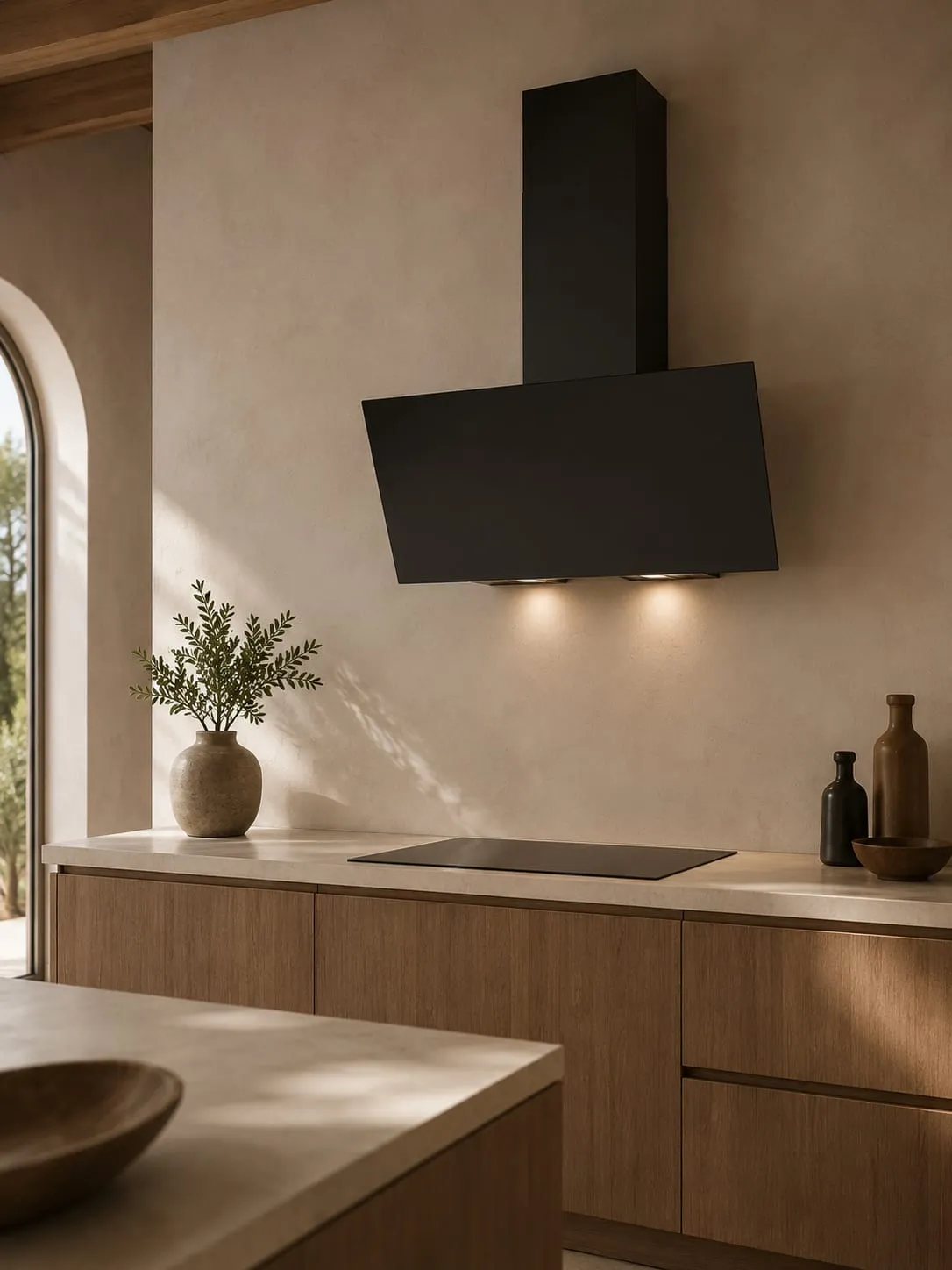
Wall-mounted decorative hoods are the most recognisable type. They are installed over the hob, fixed to the wall, and remain visible.
They can be pyramid-shaped, straight, angled, steel, black, white, glass or more discreet. They are common in linear kitchens, L-shaped kitchens and renovations where the cooking area stays against the wall.
Advantages
- There is a wide range of models and prices.
- They usually offer good extraction capacity.
- They are easy to understand and replace.
- They work well when there is a wall duct.
- They can become a decorative feature in the kitchen.
Drawbacks
- They remain visible.
- They can interrupt the line of wall units.
- In open-plan kitchens, noise matters a lot.
- If the duct is poorly solved, performance drops.
When to choose a wall-mounted decorative hood
It is a good option if the hob is against a wall, you want the hood to be visible and you have enough space to give it presence without overloading the kitchen.
It can also make sense in renovations where you want to control the budget without giving up good extraction.
Integrated extractor groups
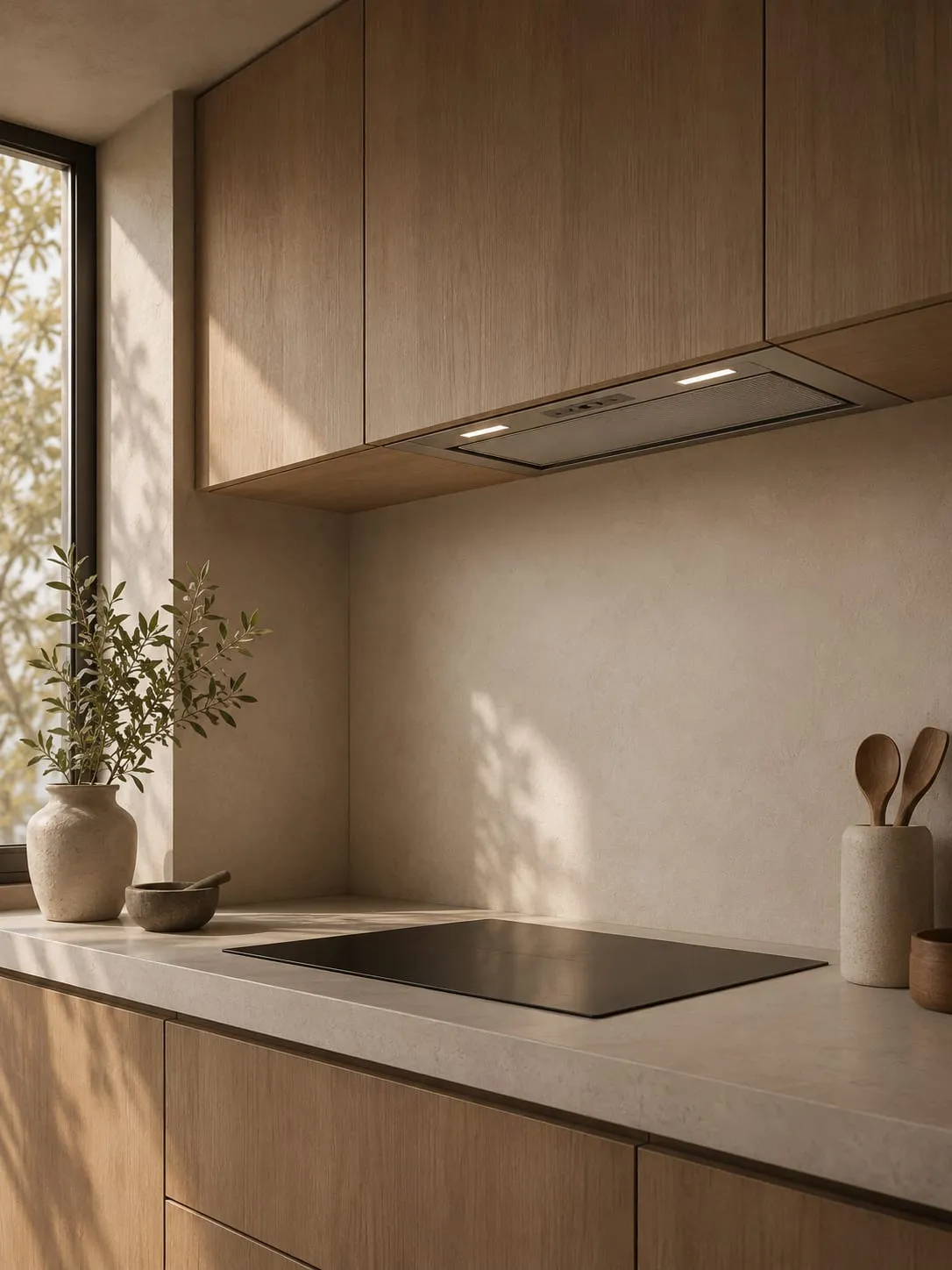
An integrated extractor group is installed inside a wall unit. From outside it is barely visible, which makes it one of the most common solutions in modern kitchens.
It keeps a clean line of units and prevents the extractor from becoming the visual focus of the kitchen.
Advantages
- It is very visually integrated.
- It works well in modern, design-led kitchens.
- It allows a continuous line of wall units.
- It can offer good power if it is sized correctly.
- It is a balanced option between aesthetics and functionality.
Drawbacks
- It takes up part of the upper unit.
- Measurements and ventilation need to be planned carefully.
- Access to filters depends on the model.
- In recirculation mode, it requires extra maintenance.
When to choose an integrated extractor group
It is one of the best options if the hob is against a wall and you want a visually clean kitchen.
In renovations where the aim is a careful look, integrated furniture and a more discreet design, it is usually a very interesting alternative.
Telescopic or pull-out hoods
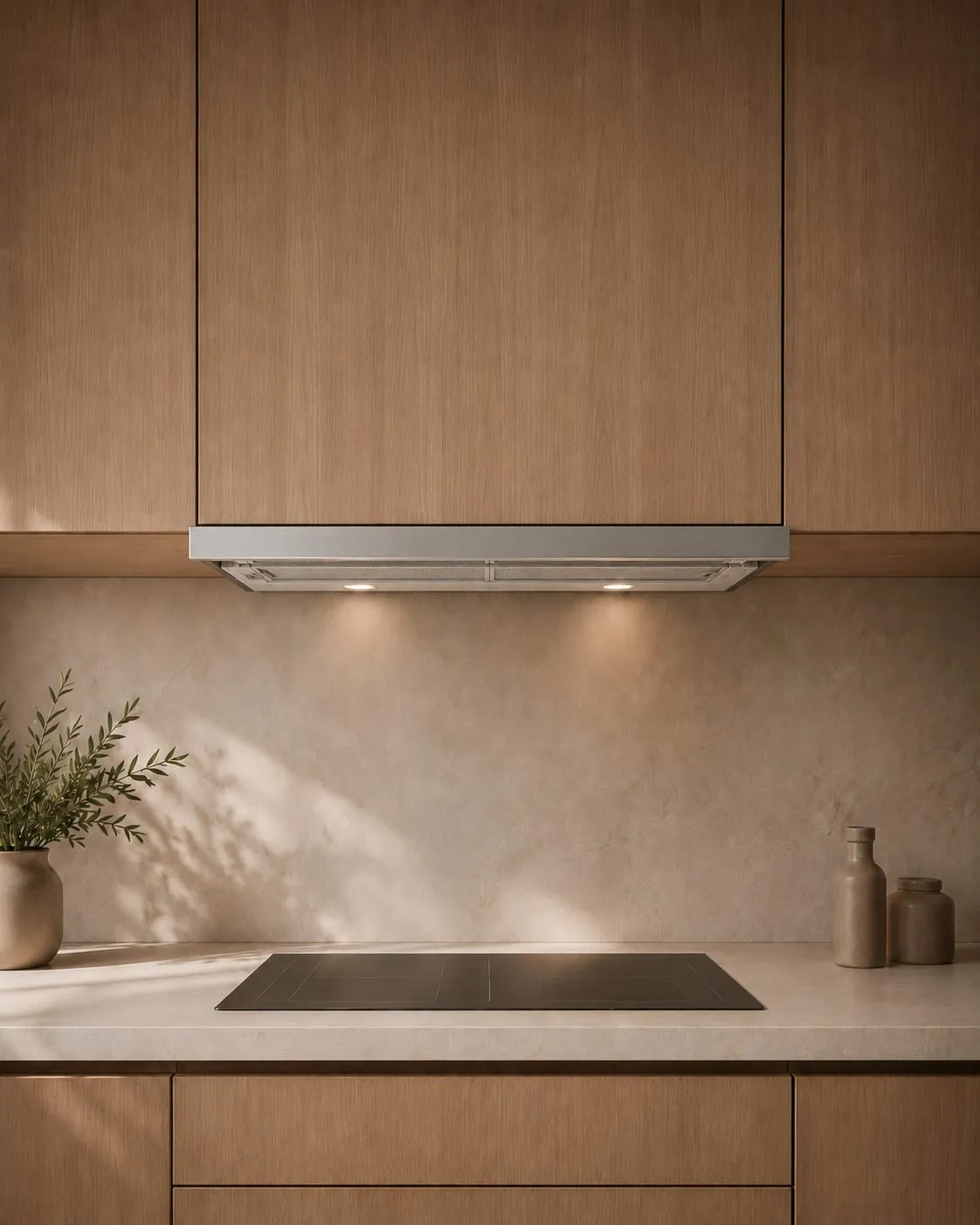
Telescopic hoods, also called pull-out hoods, are installed under a wall unit and have a front section that pulls out when you cook.
When not in use, they remain fairly discreet. That makes them practical in small kitchens or renovations where functionality and budget are important.
Advantages
- Controlled price.
- More discreet than a conventional hood.
- Practical for small kitchens.
- Installation is usually simple.
- Many models are available.
Drawbacks
- Capacity is often more limited than in higher-end models.
- Basic ranges can be noisier.
- The pull-out section collects grease.
- It is not the most aesthetic option for a design-led kitchen.
When to choose a telescopic hood
It works well in small kitchens, apartments, rental properties or renovations where the aim is a simple, discreet and economical solution.
It is not usually the first option for an open-plan kitchen, but it can solve a normal closed kitchen very well.
Conventional under-cabinet hoods
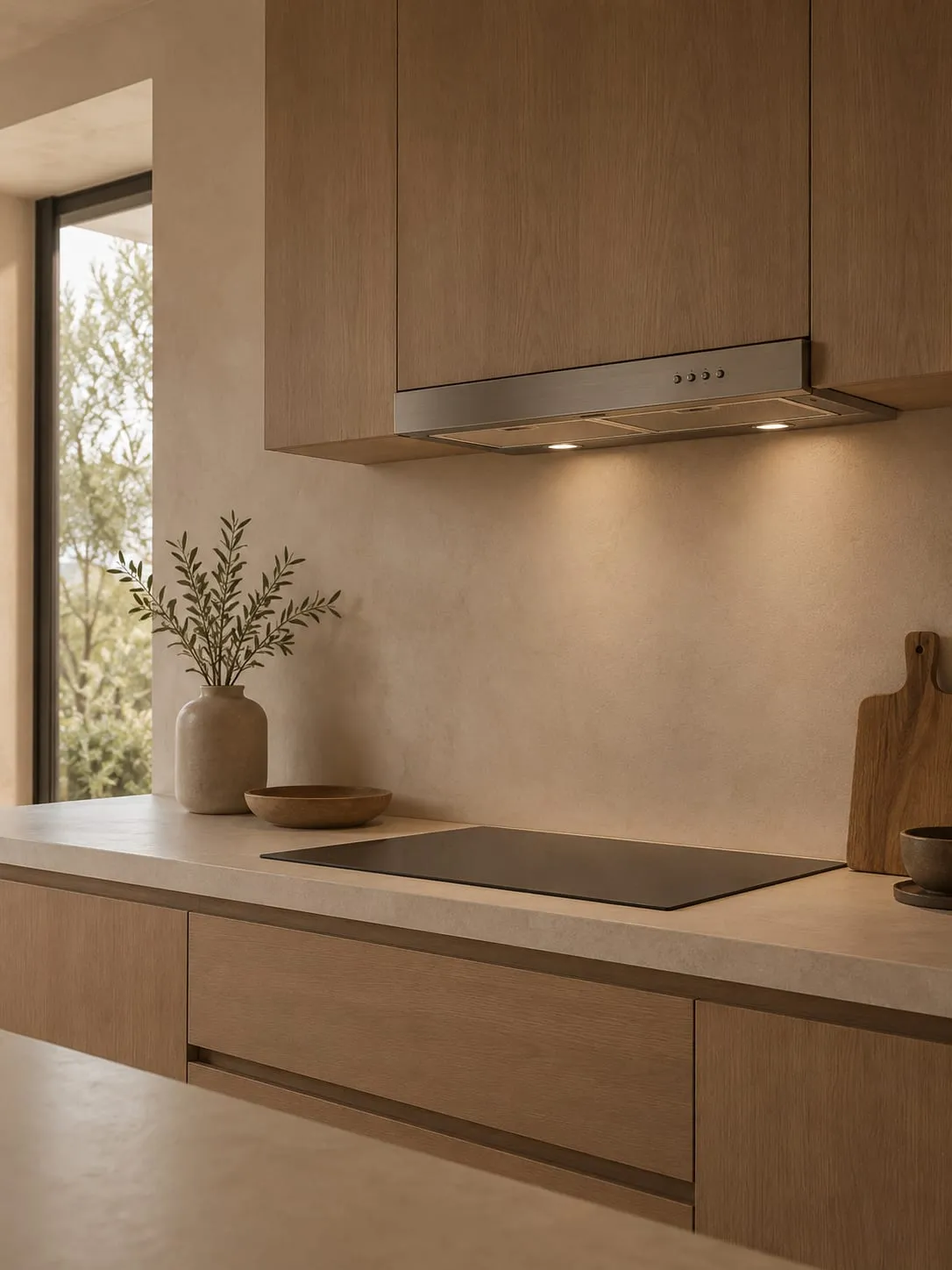
The conventional under-cabinet hood is the classic solution. It is placed under a wall unit and remains visible.
It is used less often in design-led kitchens today, but it can still be a valid option when the priority is a simple and economical solution.
Advantages
- Low price.
- Easy replacement.
- Simple maintenance.
- Good option for quick replacements.
- It can work with external extraction or recirculation.
Drawbacks
- Lower visual integration.
- Lower capacity in many models.
- More basic design.
- It can be noisy.
- It does not usually fit well in open-plan kitchens or more carefully designed projects.
When to choose a conventional hood
It makes sense in economical kitchens, rental properties, second homes or renovations where the priority is to solve extraction with a controlled investment.
Island hoods
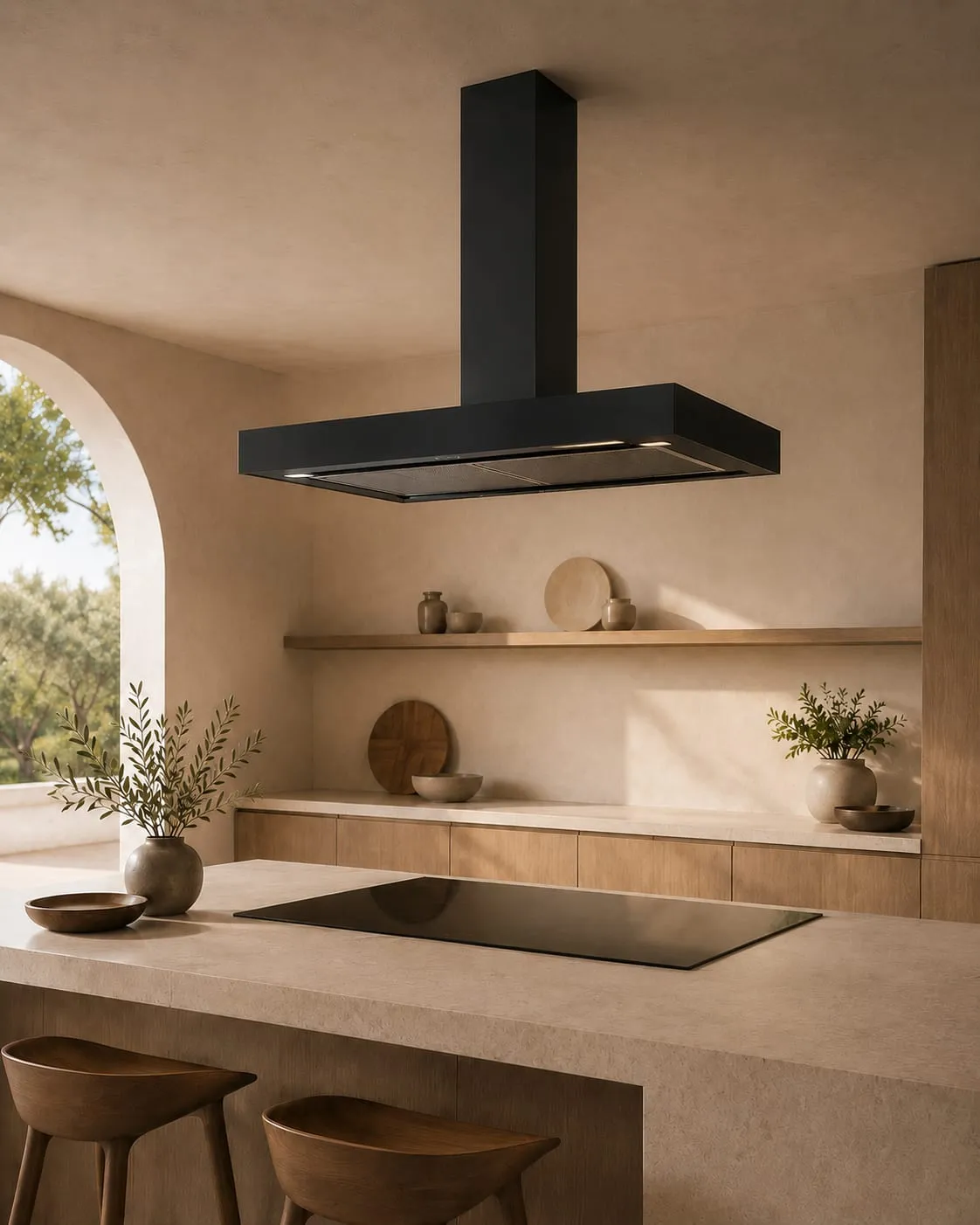
Island hoods are suspended from the ceiling over an island or peninsula. They are very visible and have a strong impact on the kitchen design.
They can work very well, but they need to be chosen carefully. On an island, fumes do not have a nearby wall to help contain them, so capture has to be planned properly.
Advantages
- Good extraction capacity.
- Specific solution for islands and peninsulas.
- It can add presence and design.
- There are many decorative models.
- It allows the hob to be placed in the centre of the kitchen.
Drawbacks
- It has a strong visual presence.
- It is usually more expensive.
- It can be noisy in open-plan kitchens.
- It needs good ceiling and ducting planning.
- If chosen badly, it can be too weak for the space.
When to choose an island hood
It is suitable when the cooking area is on an island or peninsula and you want a visible, powerful hood with presence.
If you want a visually lighter open-plan kitchen, it may be worth considering a ceiling extractor or a hob with integrated extraction.
Ceiling extractors
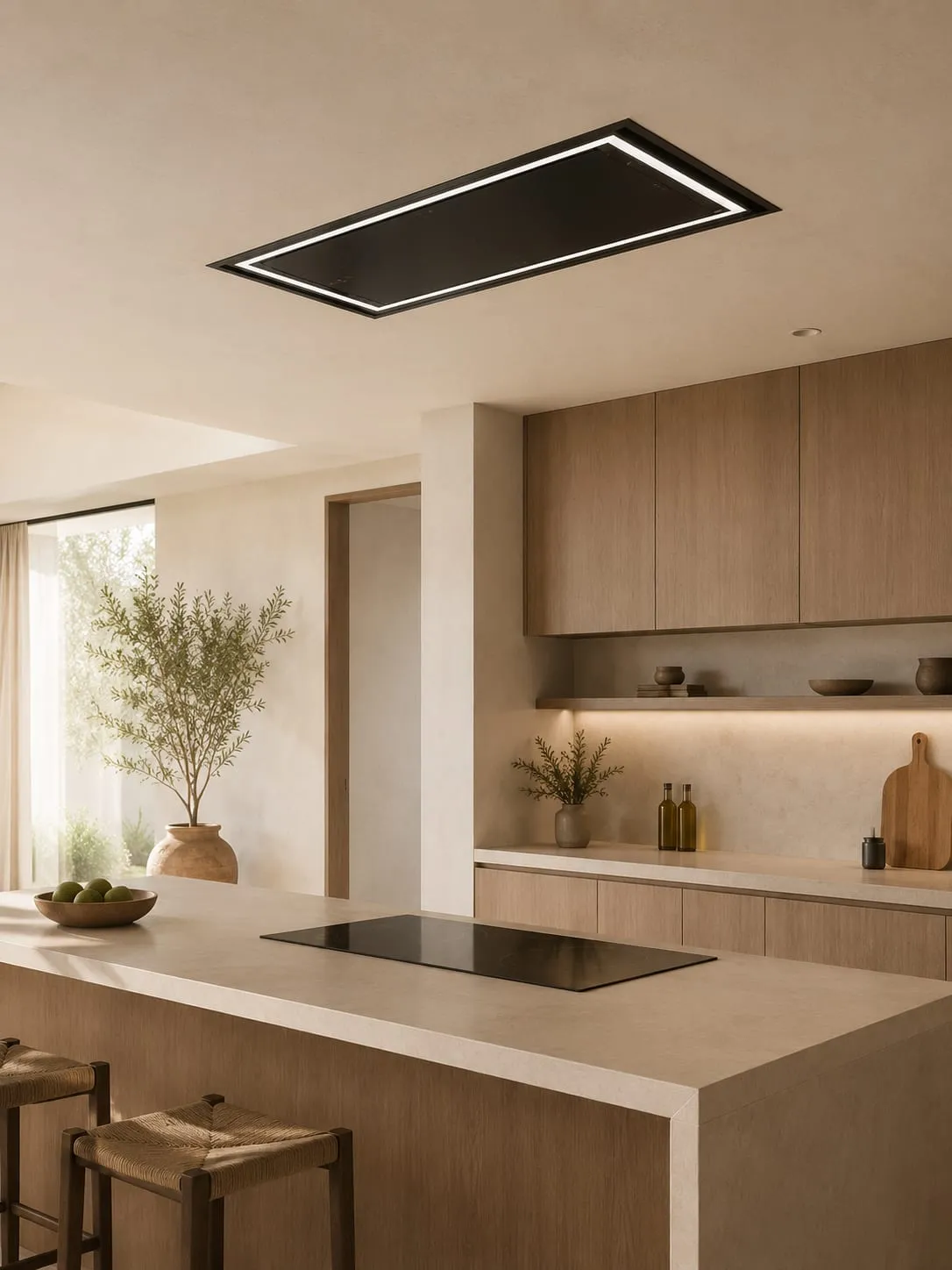
Ceiling extractors are integrated into the false ceiling or an upper structure. They are very discreet and often used in open-plan kitchens where you want to avoid a suspended hood over the island.
Their main advantage is aesthetic: they free the view and make the kitchen feel cleaner.
Advantages
- They are very integrated.
- They are ideal for open-plan kitchens.
- They do not visually interrupt an island.
- They can work well if sized correctly.
- They create a more open kitchen feeling.
Drawbacks
- Higher price.
- They need a false ceiling or prepared structure.
- They are farther away from the hob.
- They require good power and correct positioning.
- Maintenance can be less comfortable depending on the model.
When to choose a ceiling extractor
It is a good option when you want an open, minimalist kitchen without hanging elements.
In a renovation in Palma or Mallorca, it can make a lot of sense in homes where the kitchen is integrated with the living and dining area and you want to keep the look light.
Carbon-filter hoods or kitchens without external ducting
Although people often speak of a “carbon-filter hood” as if it were a type of hood, it is really an operating system.
A wall hood, integrated group, telescopic hood, ceiling extractor or even a hob with integrated extraction can work with carbon filters if it is prepared for recirculation.
It is the logical option when there is no external duct or when taking a duct outside is not viable.
Advantages
- It does not need an external duct.
- It allows kitchens to be renovated where ducting is not possible.
- There are options in many formats.
- It can solve apartments, older flats or homes with technical limitations.
- It avoids complex extraction works.
Drawbacks
- Filters need to be replaced or regenerated.
- It does not remove humidity or heat outdoors.
- It can lose effectiveness if filters are not maintained.
- It does not usually perform like good external extraction.
- In heavily used kitchens, the model has to be chosen very carefully.
When to choose a carbon-filter hood
It is the logical option when there is no external duct or when taking a duct outside is not viable.
It works better in medium- or low-use kitchens, or in homes where cooking is moderate. If you cook a lot, fry often or have an open-plan kitchen, it is worth choosing a high-quality recirculation system and accepting filter maintenance from the beginning.
Downdraft extractors and hobs with integrated extraction
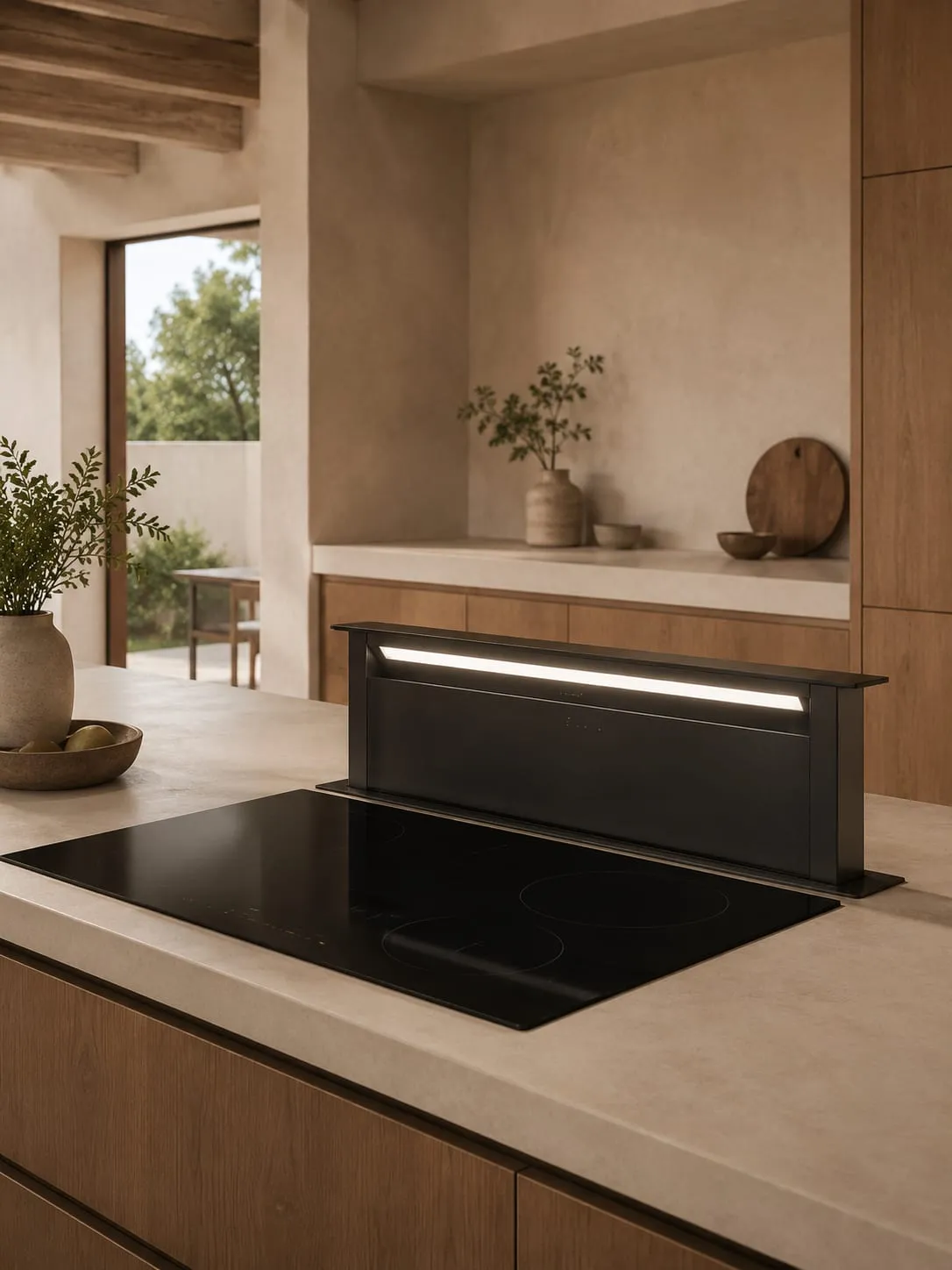
Downdraft extractors draw smoke from the cooking area instead of from above.
Here we can distinguish between downdraft units that rise from the worktop and hobs with integrated extraction, where the suction is part of the hob itself.
These solutions are widely used in design-led kitchens, especially when you want to avoid an overhead hood.
Advantages
- They remove the visual hood above the cooking area.
- They work very well in minimalist designs.
- They are interesting for islands and peninsulas.
- They allow clearer kitchen compositions.
- They can work with external extraction or recirculation.
Drawbacks
- High price.
- They need to be planned from the beginning.
- They take up space under the worktop or in the plinth.
- Maintenance can be more demanding.
- Not all systems fit all hobs or layouts equally well.
When to choose a downdraft extractor
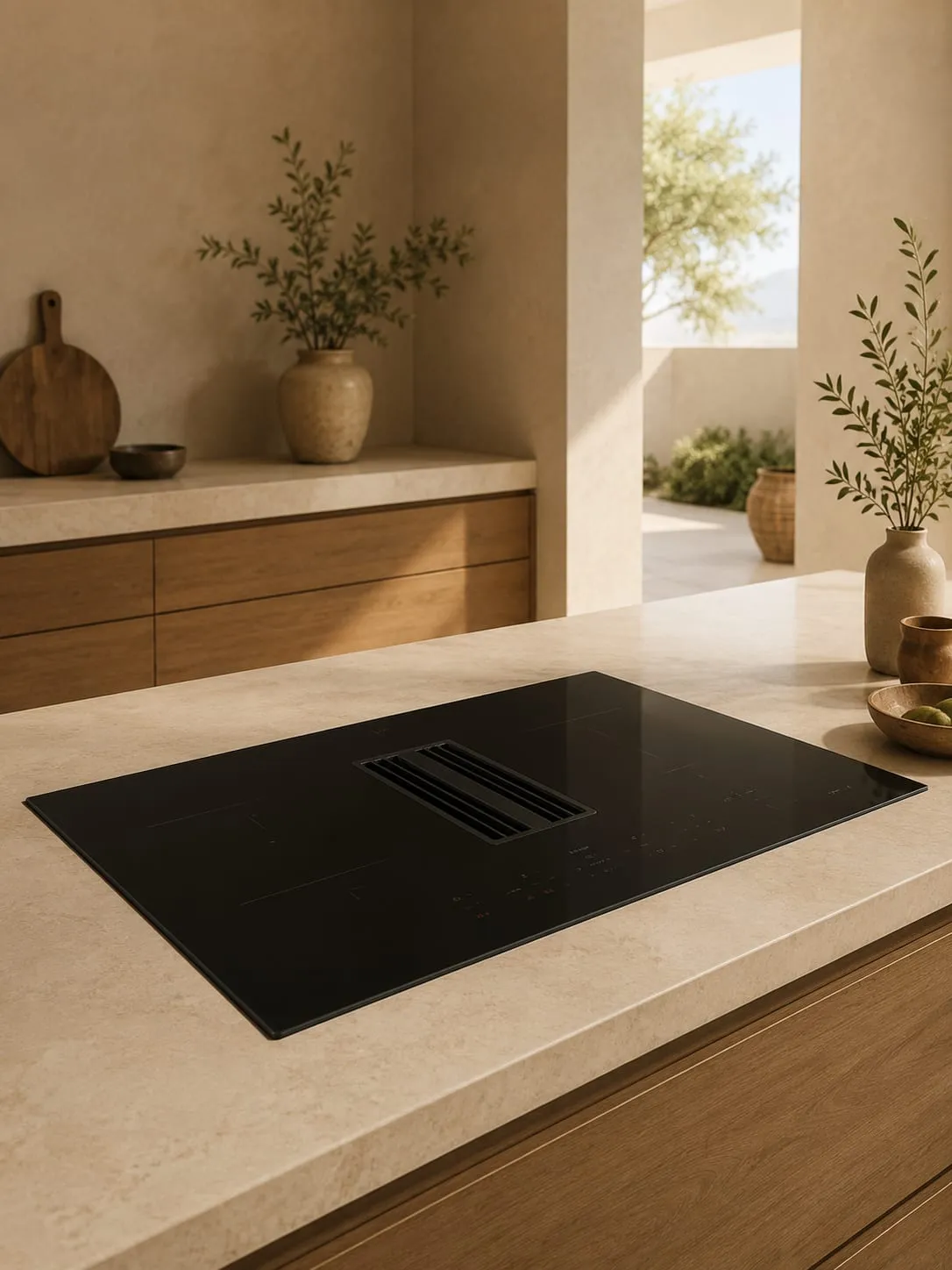
It is a good option for premium kitchens, islands, peninsulas or projects where the priority is a clean aesthetic without an overhead hood.
It can also be interesting when you do not want a hood hanging from the ceiling, although the space available under the hob and the extraction or recirculation path need to be studied carefully.
Which hood to choose depending on the kitchen
For a small kitchen
In a small kitchen, it is usually worth making the most of the space and avoiding overly bulky solutions.
The most common options are:
- Telescopic hood.
- Integrated extractor group.
- Conventional hood.
- Recirculation hood if there is no external duct.
If the space is limited, it is worth prioritising ease of cleaning, low noise and good integration with the furniture.
For an open-plan kitchen
In an open-plan kitchen, the hood is much more important. Smells, steam and noise directly affect the living area.
The most interesting options are usually:
- A powerful integrated extractor group if the hob is against a wall.
- A ceiling extractor if you want a visually lighter kitchen.
- An island hood if you want a feature piece.
- A hob with integrated extraction if you want a very clean visual result.
In open-plan kitchens, power is not enough. Noise, appearance, distance from the hob and daily use also matter.
For a kitchen with an island
If the hob is on an island, the most common options are:
- Island hood.
- Ceiling extractor.
- Hob with integrated extraction.
- Downdraft extractor.
The choice depends on whether you want the hood to be visible or not. An island hood can look spectacular, but it also has a strong visual impact. A ceiling extractor or a hob with integrated extraction keeps the area clearer.
For a home without an external duct
The usual solution is a recirculation hood with carbon filters.
It can be decorative, integrated, telescopic, ceiling-mounted or downdraft. The important thing is that the model is prepared to work without external extraction and that filter maintenance is manageable.
For a holiday home
In seasonal homes or second homes, it is usually worth choosing a hood that is easy to use, easy to clean and low maintenance.
If there is an external duct, an extraction hood is usually more comfortable. If there is not, carbon filters can be used, but it is important to be clear from the beginning about how often filters will need to be checked.
Common mistakes when choosing a kitchen extractor hood
Choosing only by appearance
The hood has to fit the design, but it also has to work well. A beautiful hood that does not extract properly or is too noisy becomes a daily problem.
Not checking whether there is an external duct
Before choosing a model, you need to know whether the home has an external duct and whether that duct can be used correctly.
If there is no duct, recirculation has to be planned from the beginning and the model has to be prepared for it.
Ignoring noise
In a closed kitchen it can be annoying. In an open-plan kitchen, it can be decisive.
A noisy hood ends up being used less, even if it is powerful.
Choosing too little power for an open-plan kitchen
In an open-plan kitchen, air moves more and smells reach the living area easily. That is why it is worth choosing a solution with good capture and not falling short.
Forgetting about maintenance
Metal filters need cleaning. Carbon filters need replacing or regenerating depending on the model. If access is uncomfortable, maintenance tends to be neglected.
Leaving the hood decision until the end of the renovation
This is especially problematic with ceiling extractors, island hoods, downdraft extractors and hobs with integrated extraction.
The hood affects furniture, ceiling, electrics, ducting, lighting and the overall design. It should not be left until the end.
Our practical recommendation
| Case | Recommended option |
|---|---|
| Wall hob and contemporary design | Integrated extractor group |
| Wall hob with visible hood | Wall-mounted decorative hood |
| Small kitchen or practical renovation | Telescopic hood |
| Very tight budget | Conventional under-cabinet hood |
| Kitchen with a feature island | Island hood |
| Minimalist open-plan kitchen | Ceiling extractor |
| Home without external ducting | Carbon-filter recirculation |
| Highly integrated kitchen without overhead hood | Hob with extractor or downdraft extractor |
At DLG.studio we do not choose the hood as an isolated piece. We assess it together with the layout, units, worktop, hob, lighting and the way you will actually use the kitchen.
Extractor hoods in kitchen renovations in Palma and Mallorca
In kitchen renovations in Palma and across Mallorca, we see many different situations: flats where every centimetre counts, open-plan kitchens, older homes without easy ducting, houses with a central island and apartments where the aim is a clean, practical renovation.
That is why it is worth studying the real space before recommending a hood. If you are renovating your kitchen, the ideal moment to decide on the extractor is when the layout is being defined.
So, which extractor hood should you choose?
If you want a clean, modern kitchen with the hob against a wall, an integrated extractor group is often one of the most balanced options. If you want a visible hood with presence, a wall-mounted decorative hood or island hood can work very well.
If there is no external duct, you will need to consider recirculation with carbon filters. And if you want a very minimalist kitchen, especially with an island, ceiling extractors, downdraft extractors and hobs with integrated extraction can be very interesting.
The key is not to choose the hood at the end. Good extraction is part of the kitchen design from the beginning. If you want us to help you plan it, tell us about your project and we will look at the best solution with you.